

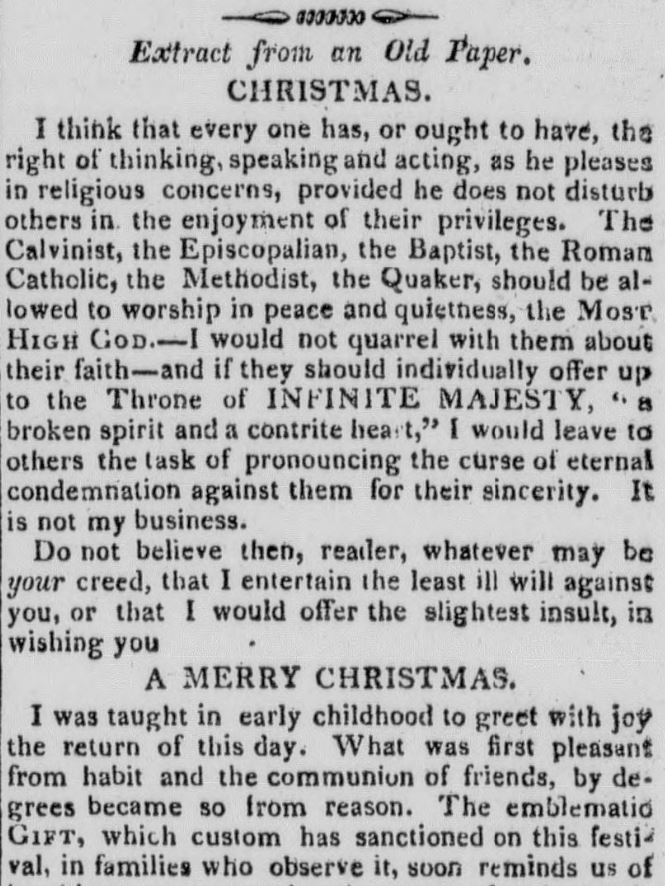
Extract from an Old Paper.
CHRISTMAS.
I think that every one has, or ought to have, the right of thinking, speaking and acting, as he pleases in religious concerns, provided he does not disturb others in the enjoyment of their privileges. The Calvinist, the Episcopalian, the Baptist, the Roman Catholic, the Methodist, the Quaker, should be allowed to worship in peace and quietness, the MOST HIGH GOD.—I would not quarrel with them about their faith—and if they should individually offer up to the Throne of INFINITE MAJESTY, “a broken spirit and a contrite heart,” I would leave to others the task of pronouncing the curse of eternal condemnation against them for their sincerity. It is not my business.
Do not believe then, reader, whatever may be your creed, that I entertain the least ill will against you, or that I would offer the slightest insult, in wishing you
A MERRY CHRISTMAS
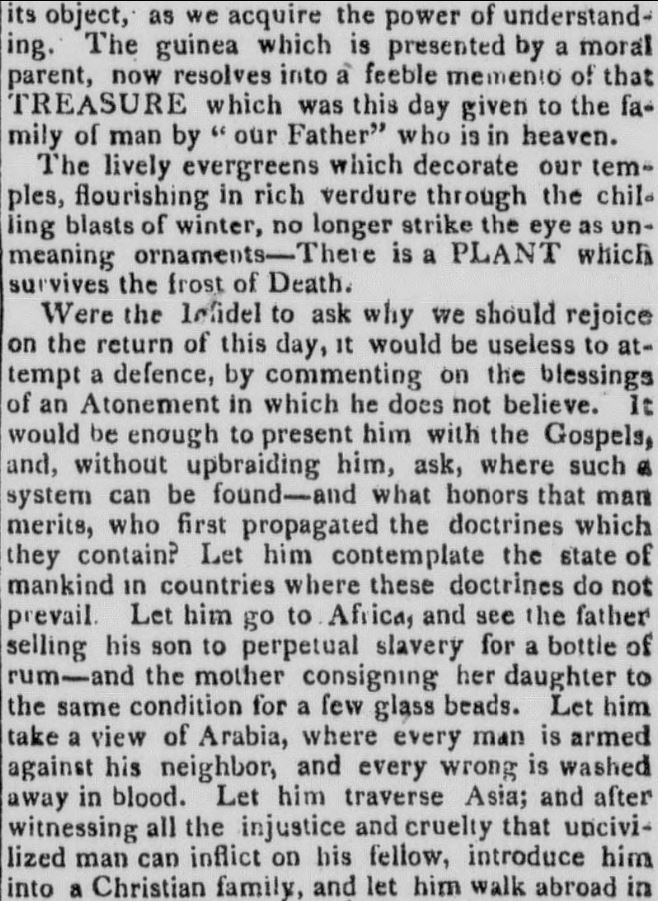
I was taught in early childhood to greet with joy the return of this day. What was first pleasant from habit and the communion of friends, by degrees became so from reason. The emblematic GIFT, which custom has sanctioned on this festival, in families who observe it, soon reminds us of its object, as we acquire the power of understanding. The guinea which is presented by a moral parent, now resolves into a feeble memento of that TREASURE which was this day given to the family of man, by “our Father” who is in heaven.
The lively evergreens which decorate our temples, flourishing in rich verdure through the chilling blasts of winter, no longer strike the eye as unmeaning ornaments—There is a PLANT which survives the frost of Death.
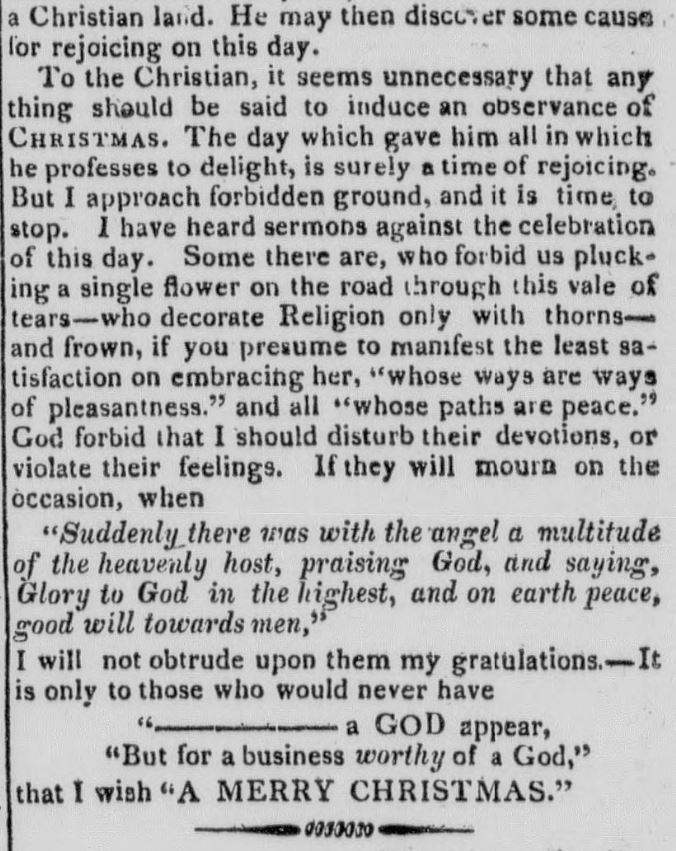
Were the infidel to ask why we should rejoice on the return of this day, it would be useless to attempt a defence, by commenting on the blessings of an Atonement in which he does not believe. It would be enough to present him with the Gospels, and, without upbraiding him, ask, where such a system can be found—and what honors that man merits, who first propagated the doctrines which they contain? Let him contemplate the state of mankind in countries where these doctrines do not prevail. Let him go to Africa, and see the father selling his son to perpetual slavery for a bottle of rum—and the mother consigning her daughter to the same condition for a few glass beads. Let him take a view of Arabia, where every man is armed against his neighbor, and every wrong is washed away in blood. Let him traverse Asia; and after witnessing all the injustice and cruelty that uncivilized man can inflict on his fellow, introduce him into a Christian family, and let him walk abroad in a Christian land. He may then discover some cause for rejoicing on this day.
To the Christian, it seems unnecessary that any thing should be said to induce an observance of CHRISTMAS. The day which gave him all in which he professes to delight, is surely a time of rejoicing. But I approach forbidden ground, and it is time to stop. Some there are, who forbid us plucking a single flower on the road through this vale of tears—who decorate Religion only with thorns—and frown, if you presume to manifest the least satisfaction on embracing her, “whose ways are ways of pleasantness.” and all “whose paths are peace.” God forbid that I should disturb their devotions, or violate their feelings. If they will mourn on the occasion, when
“Suddenly there was with the angel a multitude of the heavenly host, praising God, and saying, Glory to God in the highest, and on earth peace, good will towards men,”
I will not obtrude upon them my gratulations.—It is only to those who would never have
“------------ a GOD appear,
“But for a business worthy of a God,”
That I wish “A MERRY CHRISTMAS.”
American watchman and Delaware advertiser. [volume] (Wilmington, Del.), 20 Dec. 1822.
In the aftermath of the American Civil War, personal accounts from soldiers offered raw glimpses into the brutal realities of conflict, far removed from romanticized histories. George Cary Eggleston’s Southern Soldier Stories captures the unvarnished experiences of Confederate troops, emphasizing not just battles but the everyday struggles against scarcity and deprivation. This excerpt from his collection, titled “Random Facts,” vividly illustrates the ingenuity and endurance of Southern soldiers amid profound shortages—of clothing, medicine, ammunition, and even food—highlighting how necessity forged both practical innovations and spiritual resilience. It serves as a poignant reminder of the human cost of war, where survival often depended on makeshift solutions and unyielding determination.
https://humblymybrain.substack.com/p/confederate-soldiers-hardships-scarcity